
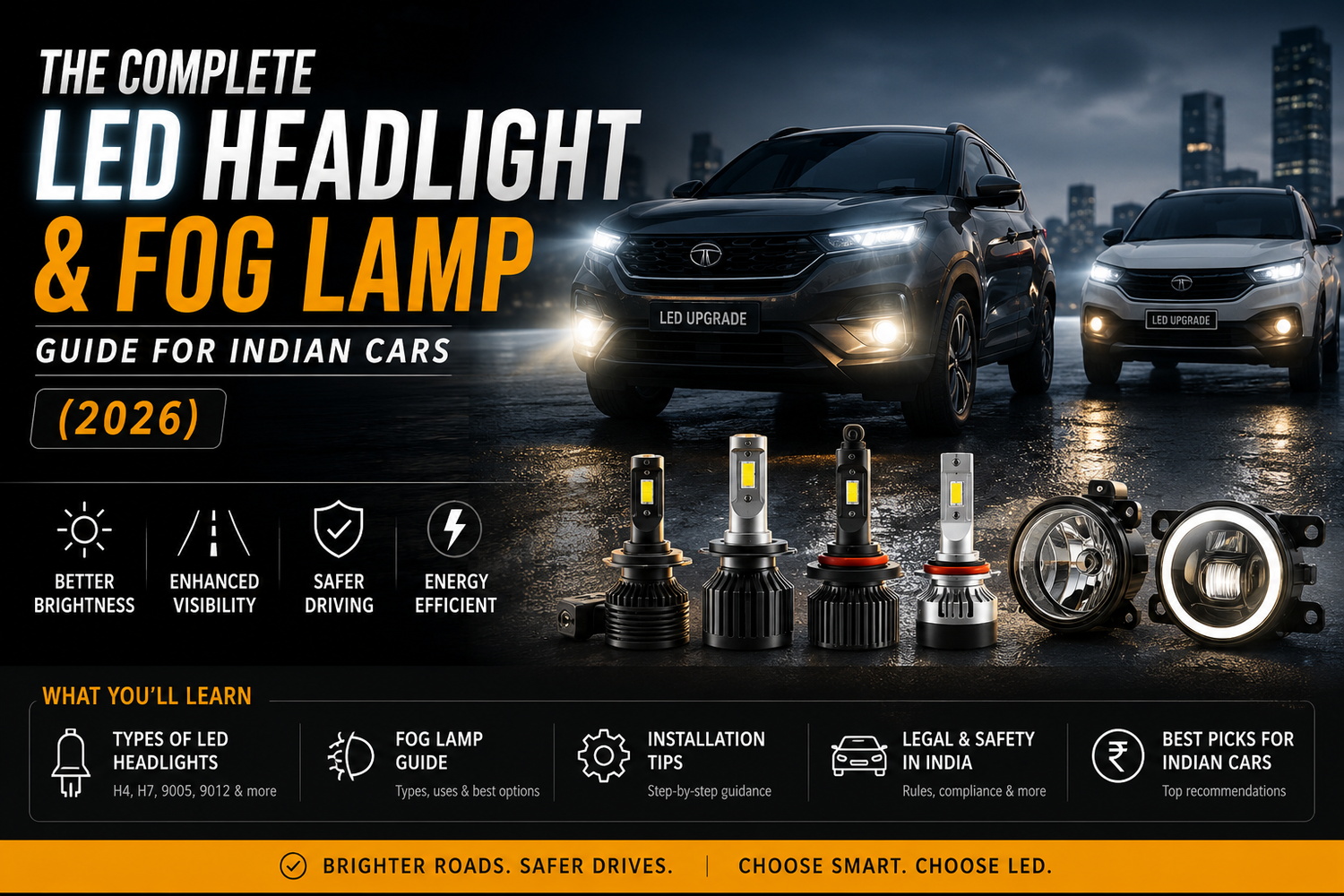
Walk into any car accessory market in India — Karol Bagh in Delhi, Lamington Road in Mumbai, or any local auto-parts shop — and you'll hear the same question a hundred times a day: "Bhai, LED lagwa du kya, ya halogen hi rakhu?" If you're asking yourself that exact thing right now, you're in the right place.
This guide answers every question Indian car owners actually search for before buying an LED headlight or fog lamp upgrade in 2026 — from choosing between H4 and H7 bulbs, to understanding wattage, colour temperature, IP ratings, legality under RTO rules, and how long these bulbs really last. By the end, you'll know exactly which CARSFY LED kit fits your car and your driving needs, with zero guesswork.
Quick answer for the busy reader: If you drive mostly in cities, a CARSFY 100W 6000K LED headlight gives you a massive upgrade over stock halogen at an affordable price. If you do regular highway driving at night, go for the 220W or 300W series for maximum throw and visibility. Not sure which bulb size your car needs? Jump to the bulb size table below or use our live chat — we'll confirm fitment in under 2 minutes.
What This Guide Covers
• H4 vs H7 vs other bulb sizes — which one does your car use?
• 100W vs 220W vs 300W — how much wattage do you actually need?
• Halogen vs LED — is the upgrade really worth the money?
• 6000K vs 3000K vs 8000K — which colour temperature is best for Indian roads?
• IP68 waterproofing — why it matters in Indian monsoons
• Are aftermarket LED headlights legal in India? (RTO rules explained)
• Projector fog lamps vs standard fog lamps
• Auxiliary lights vs LED headlights — do you need both?
• How long do LED headlights actually last?
• What "German technology" (Deutsche Technik) really means Frequently asked questions (FAQ)
1. H4 vs H7 vs Other Bulb Sizes — Which One Does Your Car Use?
Before you buy any LED headlight, the single most important thing is fitment. The two most common headlight bulb sockets in Indian cars are H4 and H7, and they are not interchangeable without the right adapter.
H4 bulbs — the all-in-one socket
An H4 bulb does both jobs in one bulb — low beam (city driving) and high beam (highway/dipper) — using a single base. This is the most common socket in budget and mid-range hatchbacks and sedans in India, including most generations of the Maruti Suzuki Swift, WagonR, Alto, and Hyundai Santro.
H7 bulbs — dedicated low beam
An H7 bulb is a single-filament, single-beam bulb — usually dedicated to either low beam or high beam, with a separate bulb handling the other. H7 is common in slightly higher trim sedans and SUVs such as the Hyundai Creta, Honda City, and several Tata and Mahindra models, often paired with an H1 or HB3 for high beam.
Other common sizes you'll come across
• H8 / H11 / H16 — commonly used for fog lamps across Maruti, Hyundai, and Tata models
• 9005 (HB3) / 9006 (HB4) — common in some Honda, Toyota, and imported/CBU models for high or low beam
• HIR2 — found in newer Hyundai and Kia SUVs for high-output halogen-replacement fitments
Bulb compatibility — quick reference table
|
Car model (popular in India) |
Headlight bulb (typical) |
Fog lamp bulb (typical) |
|
Maruti Suzuki Swift / WagonR / Alto |
H4 |
H8 / H11 |
|
Maruti Suzuki Baleno / Dzire |
H4 / H11 |
H8 / H11 |
|
Hyundai i20 / Venue |
H4 / H7 |
H8 / H11 |
|
Hyundai Creta |
H7 / H1 |
H8 / H11 |
|
Tata Nexon / Punch |
H4 / H7 |
H8 / H11 |
|
Honda City / Amaze |
H11 / H4 |
H8 / H11 |
|
Mahindra XUV700 / Scorpio-N |
H7 / HIR2 |
H11 |
|
Toyota Fortuner / Innova Crysta |
H11 / HB3 |
H8 / H11 |
Always confirm the exact fitment for your variant and manufacturing year — bulb sizes can change between facelifts. Not sure? Message us your car's registration details or VIN on WhatsApp and our team will confirm the correct CARSFY bulb size before you order — no guesswork, no returns hassle.
2. 100W vs 220W vs 300W — How Much Wattage Do You Actually Need?
CARSFY LED headlight range comes in three power tiers — 100W, 220W, and 300W — and the right choice depends entirely on how and where you drive, not just on "more is always better."
100W — best for city and daily commuting
If most of your driving is within city limits — Bengaluru traffic, Mumbai's local roads, or Delhi's well-lit arterial roads — a 100W LED headlight already delivers a dramatic improvement over stock halogen bulbs (which are typically rated 55W–65W with far lower light output). You get sharper, whiter light for better visibility at junctions, during rain, and in poorly lit residential lanes, without unnecessary overkill.
220W — the sweet spot for mixed city + highway driving
220w is the CARSFY most popular tier, and for good reason. If you regularly drive on state highways, expressways like the Mumbai-Pune or Yamuna Expressway, or take weekend trips out of the city, 220W gives you significantly longer beam throw — meaning you spot potholes, stray animals, and unlit vehicles much earlier, which directly translates to safer reaction time.
300W — for serious highway and night drivers
If you're a long-haul driver, frequently travel on poorly lit national highways, or drive in hilly/ghat sections with minimal street lighting, the 300W tier offers maximum brightness and the widest beam spread. This is the choice for owners who prioritise absolute maximum visibility over everything else.
Wattage decision table
|
Driving profile |
Recommended wattage |
Why |
|
Daily city commute (under 30 km/day) |
100W |
Big upgrade over halogen, most affordable, sufficient for lit roads |
|
Mixed city + occasional highway |
220W |
Best balance of brightness, beam throw, and price |
|
Frequent highway / night driving / ghat roads |
300W |
Maximum visibility and beam distance for unlit stretches |
Still unsure? Browse the full CARSFY LED headlight range here — every listing shows lumen output, beam pattern, and recommended use case so you can compare side by side before buying.
3. Halogen vs LED — Is the Upgrade Really Worth the Money?
Most cars sold in India under ₹12 lakh still come with halogen headlights as standard — even in 2026. Halogens were fine for the roads of the 1990s, but Indian traffic conditions today — poor street lighting on highways, sudden fog in North India winters, and increasingly crowded city roads — demand better.
The honest comparison
|
Factor |
Halogen (stock) |
CARSFY LED upgrade |
|
Brightness |
Typically 700–1,200 lumens |
Up to 22,000 lumens (300W kit) |
|
Colour |
Yellowish (around 3000K) |
Crisp white (6000K) |
|
Heat generation |
High — bulbs run very hot |
Significantly lower, better thermal design |
|
Lifespan |
300–1,000 hours typical |
Rated up to 50,000+ hours |
|
Power draw |
Higher current draw on old wiring |
Lower power draw, easier on electricals |
|
Installation |
Plug-and-play (same as stock) |
Plug-and-play, no cutting or rewiring needed |
Is it worth the cost?
Yes, CARSFY LED upgrade typically costs a fraction of what a dealership-fitted projector retrofit costs, and pays for itself many times over in halogen bulb replacements alone — a stock halogen bulb in heavy use often needs replacing every 6–12 months, while a CARSFY LED is built to outlast the car's ownership cycle. For a one-time investment of a few thousand rupees, you get a meaningfully safer driving experience every single night.
4. 6000K vs 3000K vs 8000K — Which Colour Temperature Is Best for Indian Roads?
Colour temperature (measured in Kelvin) describes the colour of light a bulb produces — and it's one of the most misunderstood specs when buying LED headlights.
3000K — warm yellow
This is close to traditional halogen colour. It performs reasonably in fog and rain because yellow light scatters less in moisture, but it looks dated and provides lower contrast on dry roads compared to whiter light.
6000K — crisp white (CARSFY standard)
6000K is widely considered the sweet spot for Indian conditions. It's bright, white, and provides excellent contrast on tarmac, lane markings, and road signs — closer to daylight colour, which reduces eye strain on long drives. This is why the CARSFY core range is built around 6000K.
8000K and above — blue-tinted white
Beyond 6000K, light starts taking on a blue tint. While it looks premium, very high Kelvin values can actually reduce effective brightness in fog and rain because blue light scatters more in moisture — making 8000K+ more of a style choice than a functional upgrade for most Indian driving conditions.
Our recommendation
For year-round Indian driving — including monsoon season — 6000K offers the best balance of brightness, clarity, and all-weather performance. This is the colour temperature used across CARSFY 100W, 220W, and 300W headlight ranges.
5. IP68 Waterproofing — Why It Matters in Indian Monsoons
If you've ever driven through a waterlogged street in Mumbai, Chennai, or Bengaluru during monsoon season, you already know how much abuse a car's headlight housing takes — splashes, submersion in puddles, and constant humidity.
What does IP68 actually mean?
IP ratings follow the format IPxy, where the first digit (x) rates protection against dust and the second digit (y) rates protection against water. IP68 is the highest practical rating for automotive lighting — it means the unit is completely dust-tight (6) and can withstand continuous submersion in water beyond 1 metre depth (8).
Why this matters for your CARSFY purchase
- Driving through waterlogged streets won't cause the LED driver to short out or fog up internally
- Humidity buildup inside the headlight housing — common with cheaper aftermarket LEDs — is prevented
- The bulb's lifespan rating (50,000+ hours) only holds up if moisture can't degrade the internal components — which is exactly what IP68 sealing protects against
This is one spec where it's worth refusing to compromise. A bulb that looks identical but lacks proper IP68 sealing may work fine in dry weather and then fail completely the first time you drive through a flooded underpass. Every CARSFY LED headlight and fog lamp is IP68 rated as standard — no upsell required.
6. Are Aftermarket LED Headlights Legal in India? (RTO Rules Explained)
This is the single most common hesitation we hear from buyers — and it deserves an honest, factual answer rather than marketing spin.
What the rules generally say
Under the Central Motor Vehicles Rules, modifications to a vehicle's lighting that alter the originally approved configuration in a way that increases glare to oncoming traffic, or that involve unauthorised structural changes to the headlight housing, can attract scrutiny during RTO inspections or PUC/fitness checks. The specific enforcement varies by state and is occasionally subject to crackdowns, particularly around aggressive HID conversion kits that cause severe oncoming glare.
Where CARSFY LED bulbs differ from problematic kits
- CARSFY LED bulbs are designed as direct plug-and-play replacements for the existing bulb socket — there is no cutting, drilling, or structural modification to the headlight housing
- They retain the same form factor and beam-focusing position as the original halogen bulb, which helps preserve the factory-designed beam pattern
- 6000K colour temperature is chosen specifically to stay close to a natural white that doesn't produce the harsh blue-purple glare associated with poorly made HID kits
Our honest advice
We can't make a blanket "100% legal everywhere" claim — vehicle modification laws and enforcement practices can vary by state and change over time, and we're not a law firm. What we can say is: choose a plug-and-play LED bulb replacement (like CARSFY) over an HID conversion kit, always get your headlight beam alignment checked after installation (see our installation guide), and avoid bulbs with extreme colour temperatures (10,000K+) that produce excessive glare. This keeps your upgrade as close as possible to factory-intended lighting while dramatically improving brightness.
7. Projector Fog Lamps vs Standard Fog Lamps
Fog lamps exist to do one job: cut through fog, heavy rain, and dust without blinding oncoming drivers. The design of the lamp determines how well it does that job.
Standard (reflector) fog lamps
These bounce light off a curved reflector dish toward the road. They're simple and affordable, but the beam tends to scatter more, which can create a wall of glare that bounces back off fog particles — sometimes making visibility worse, not better.
Projector fog lamps
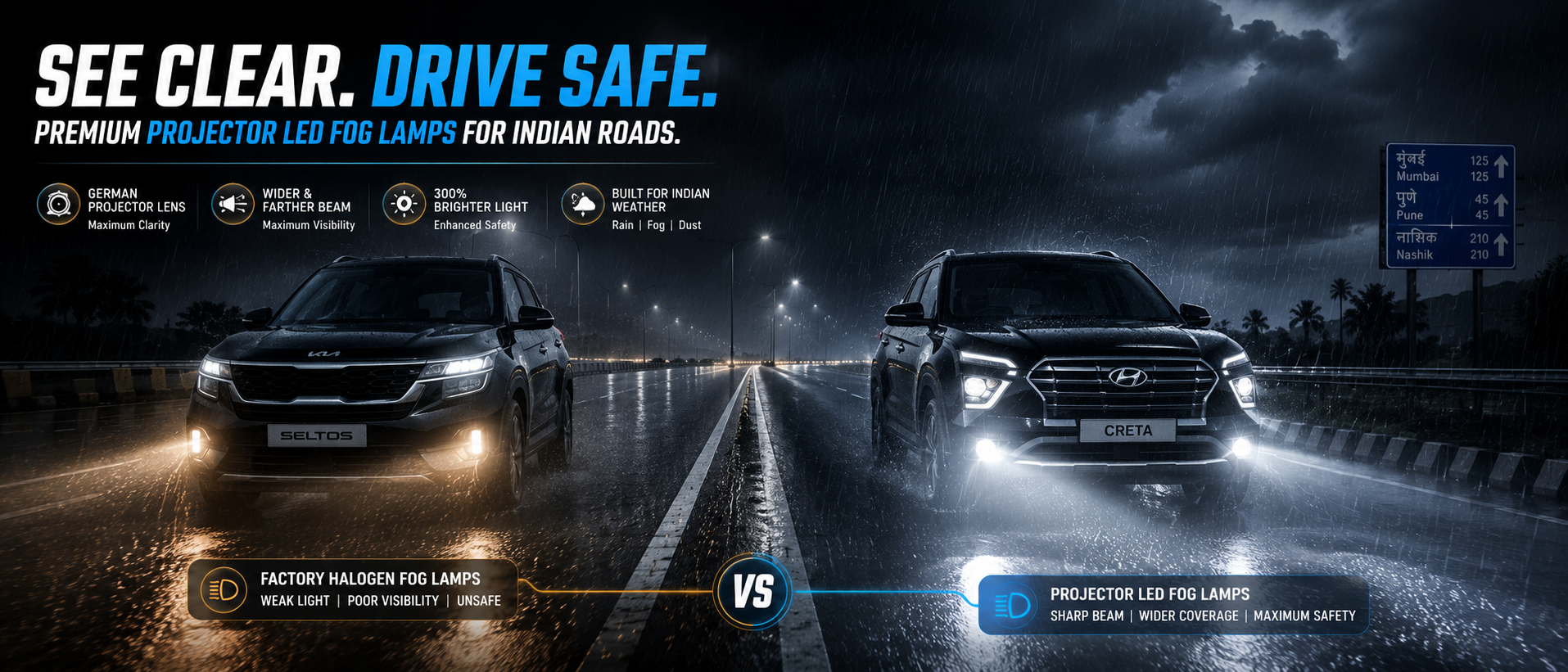
Projector-style fog lamps use a lens to focus light into a tighter, more controlled beam with a sharper cut-off line. This means more light goes onto the road surface in front of you, and less light scatters upward into the fog itself — exactly the effect you want when driving through North India's winter fog on the Delhi-Agra or Lucknow-Kanpur stretches.
Bottom line
If your car's fog lamp housing supports a projector-style replacement, it's a worthwhile upgrade for anyone who regularly drives during winter mornings, monsoon downpours, or hilly mist conditions — situations where Indian roads genuinely become hazardous without good lighting.
8. Auxiliary Lights vs LED Headlights — Do You Need Both?
These two products solve different problems, and many serious night-drivers in India eventually run both.
|
|
LED headlight upgrade |
Auxiliary / off-road lights |
|
Purpose |
Replace your existing low/high beam for everyday driving |
Supplementary lighting for highway, off-road, or extreme low-visibility conditions |
|
Mounting |
Inside existing headlight housing (plug-and-play) |
Bull-bar, roof, or bumper mounted (additional fitment) |
|
Best for |
Every car owner — immediate upgrade over halogen |
Highway commuters, road-trippers, off-roaders, farm/rural drivers |
|
Typical use case |
Daily driving, city, highway |
Long highway stretches, unlit rural roads, off-road trails |
Recommendation: start with the LED headlight upgrade — it's the highest-impact change for the cost and benefits every driving scenario. If you frequently drive on highways or rural roads with minimal street lighting, add auxiliary lights as a second step for maximum coverage.
9. How Long Do LED Headlights Actually Last? (The Truth About 50,000-Hour Claims)
You'll see LED lifespan claims ranging from 30,000 to 100,000 hours across different brands — and it's fair to be skeptical. Here's what actually determines how long an LED headlight lasts in the real world.
What controls LED lifespan
- Heat sink design — LEDs degrade faster when they overheat; a well-designed aluminium heat sink with proper fan or passive cooling is the single biggest factor
- Driver circuit quality — the electronic driver that regulates current to the LED chips needs to handle India's variable voltage (especially in older cars with less stable alternators) without flickering or overdriving the chips
- Sealing — as covered in the IP68 section, moisture ingress is one of the fastest ways to kill an LED's internal electronics regardless of the chip's rated lifespan
- Operating temperature — a bulb rated for 50,000 hours in a lab at 25°C may perform differently in an engine bay that regularly hits 60-70°C in Indian summers, which is why thermal design matters more than the headline number
What this means for your purchase
A lifespan claim is only meaningful when paired with proper heat management and IP68 sealing — which is exactly the combination CARSFY German-engineered thermal design is built around. Realistically, this means an LED bulb that, under normal use, should comfortably outlast your ownership of the vehicle — with CARSFY warranty backing that promise.
10. What "German Technology" (Deutsche Technik) Really Means at CARSFY
"German technology" gets thrown around a lot in the automotive accessory space in India, often without explanation — so here's what it actually refers to for CARSFY products.
- Thermal management design principles adapted from German automotive lighting engineering standards, focused on heat dissipation that protects the LED chip's lifespan
- Driver IC (the circuit that regulates power to the LED) designed for stable output across voltage fluctuations — relevant for Indian vehicles with varying electrical system conditions
- Strict quality control on beam focus and chip placement, since even a 1-2mm misalignment in chip positioning can scatter the beam pattern and reduce effective road illumination
We'd rather be upfront: this doesn't mean every component is manufactured in Germany. It means the engineering specifications and quality benchmarks CARSFY products are built to follow originate from these standards — which is what separates a CARSFY LED from a generic unbranded bulb you might find for a fraction of the price with no thermal design consideration at all.
Frequently Asked Questions
Will a CARSFY LED bulb fit my car without any modification?
Yes. CARSFY LED headlight and fog lamp bulbs are designed as direct plug-and-play replacements for the standard halogen socket in your car (H4, H7, H8, H11, and other common sizes). No cutting, drilling, or rewiring is required. If you're unsure of your exact bulb size, share your car's model and variant with our team before ordering.
Can I install CARSFY LED bulbs myself, or do I need a mechanic?
Most installations take under 15-20 minutes and can be done at home with basic tools — see our dedicated installation guide for a step-by-step walkthrough. If you're not comfortable opening your headlight housing, any local mechanic or accessory shop can install it in a few minutes.
Will an LED upgrade drain my car's battery faster?
No — in fact, LED bulbs draw less power than halogen bulbs for significantly more light output, which is generally easier on your car's electrical system, not harder.
What's the difference between CARSFY 100W, 220W, and 300W kits?
The wattage figure represents the total power draw and light output of the kit. Higher wattage means brighter output and longer beam throw, which matters more for highway and night driving. See the wattage comparison table above for a full breakdown by use case.
Are CARSFY LED headlights waterproof for monsoon driving?
Yes — all CARSFY LED headlight and fog lamp products carry an IP68 rating, the highest practical waterproofing standard for automotive lighting, meaning they're built to handle heavy rain and waterlogged roads without internal moisture damage.
Do LED headlights affect my headlight's beam pattern or cause glare to oncoming drivers?
A correctly fitted LED bulb that matches the original bulb's form factor (as CARSFY bulbs do) is designed to preserve the headlight's factory beam pattern. We recommend checking beam alignment after any bulb replacement — see our alignment guide — to ensure the beam is aimed correctly and doesn't cause glare.
What warranty does CARSFY offer on LED headlight bulbs?
CARSFY backs its LED headlight and fog lamp range with a manufacturer warranty covering manufacturing defects. Check the specific product listing for the exact warranty period applicable to your chosen kit, or contact our support team for details.
Which CARSFY product should I buy for my car?
If you're still deciding, here's the simplest way to choose: match your driving profile to the wattage table in Section 2, confirm your bulb size using the compatibility table in Section 1, and choose 6000K (CARSFY standard) for the best all-weather performance. Still unsure? Message our team on WhatsApp with your car model — we'll recommend the exact product and confirm fitment before you buy.
Ready to Upgrade Your Car Lighting?
Whether you're commuting daily through city traffic, planning a highway road trip this winter, or just tired of squinting through halogen yellow light on a rainy night — there's a CARSFY LED kit built for your exact driving needs.
- Browse the full CARSFY LED headlight range (100W / 220W / 300W, 6000K)
- Explore CARSFY projector fog lamps for winter and monsoon driving
- Check the car compatibility hub to confirm your bulb size instantly
- Chat with our team on WhatsApp for personalised fitment advice
CARSFY — for Indian Roads.

Leave a comment
This site is protected by hCaptcha and the hCaptcha Privacy Policy and Terms of Service apply.