

How to Choose the Best High-Power Light for Night Driving
Your Stock Headlights Are Not Enough — Here Is Why
You are driving on NH44 at 10 PM, somewhere between Nagpur and Hyderabad. The road is straight, traffic is light — but beyond your headlight beam, the world is pitch black. A stray dog sits in the middle of the lane. You see it at 30 metres. That is barely enough time to react at 80 km/h.
Factory-fitted headlights are designed for urban roads — well-lit streets, slower speeds, predictable traffic. They are never designed for the realities of Indian night driving: unlit state highways, sudden animals on the road, unmarked speed breakers, fog patches, or the blinding dust of off-road tracks.
This is exactly why thousands of Indian drivers are upgrading to a 110W auxiliary lamp. Not as a cosmetic mod but as a genuine safety upgrade that could prevent accidents, save lives, and transform your nighttime driving experience.
This guide covers everything you need to know: what a 110W auxiliary lamp actually does, how it compares to fog lights and lower-watt alternatives, which beam type to choose, legal requirements in India, and how to install one on your car.
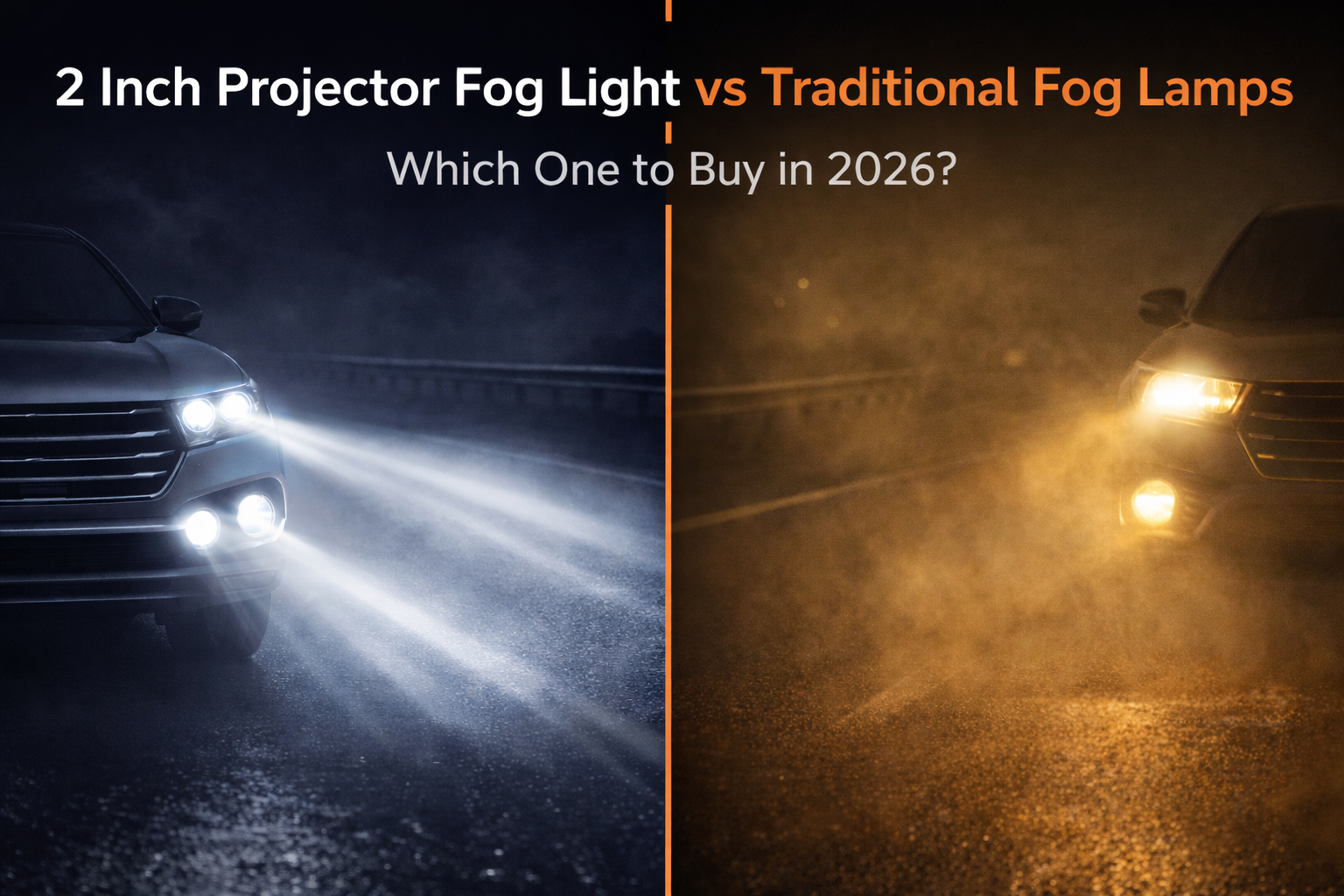
Auxiliary Lamps vs Fog Lights: What Is the Difference?
Many car owners confuse auxiliary lamps and fog lights. They are not the same — and knowing the difference helps you pick the right product.
Fog Lights
Mounted low on the bumper. Designed to project a wide, flat beam close to the ground — cutting under the fog layer without reflecting back into your eyes. Best for fog, rain, and low-visibility city driving. Typically 35W–100W.
Auxiliary Lamps
Mounted higher — on the roof, bull bar, or A-pillar. Designed to project a long-distance forward beam that extends well beyond your main headlights. Used for highways, off-road trails, and any situation where you need to see much further ahead. A 110W auxiliary lamp is the most popular high-power choice for Indian roads.
In short: fog lights illuminate close and wide. Auxiliary lamps illuminate far and forward. Many Indian car and SUV owners fit both — a fog light pair for weather conditions plus a 110W auxiliary lamp for highway and off-road use.
Benefits of a 110W Auxiliary Lamp
1. Long-Distance Visibility — See 120 Metres Ahead
The biggest benefit of a 110W auxiliary lamp is raw throw distance. At 5,700K colour temperature and 10,000+ lumens, a quality unit projects a clean beam up to 120 metres ahead — nearly 3x the range of factory halogen headlights. This gives you 4–5 seconds of extra reaction time at highway speeds. That extra time is not a luxury. It is the difference between safe braking and a collision.
2. Off-Road Performance — See Every Rock, Rut, and Ridge
Off-road drivers — whether you are on forest tracks in Coorg, rocky trails in Ladakh, or muddy paths in the Western Ghats — face hazards that headlights simply cannot reveal in time. A 110W auxiliary lamp mounted on a bull bar or roof rack floods the trail ahead with powerful light, revealing elevation changes, water crossings, and obstacles before you drive into them.
3. Highway Safety — Every Night Drive, Every Trip
India has one of the highest rates of night-time road accidents in the world. Poorly lit national and state highways, sudden diversions, unmarked construction zones — all are invisible to standard headlights. A 110W auxiliary lamp provides the visibility margin you need to drive confidently at 80–100 km/h on dark highways.
4. LED Efficiency — 30,000+ Hours, Low Heat
Modern 110W LED auxiliary lamps are far more efficient than their wattage suggests. Quality units use high-efficiency LED chips and aluminium heat-sink housings that keep operating temperatures low. Lifespan of 30,000+ hours means these lights will almost certainly outlast your vehicle.
5. All-Weather Durability
Top-rated 110W auxiliary lamps come with IP67 or IP68 waterproofing — fully protected against rain, monsoon splashes, river crossings, and road spray. A sealed polycarbonate or glass lens also resists vibration damage on rough roads.
Recommended Product:
For a top-rated option, check out the Carsfy CLA3010 3-Lens 200W 5700K Auxiliary Lamp — a powerful, triple-lens auxiliary lamp designed for Indian road and off-road conditions.
Beam Types Explained: Spot vs Flood vs Combo
Not all 110W auxiliary lamps produce the same beam. Choosing the right beam type for your driving style is critical.
|
Beam Type |
Pattern |
Best For |
Throw Distance |
|
Spot |
Narrow & focused |
Highways, long-distance |
150 m+ |
|
Flood |
Wide & low |
Off-road, curves, camping |
Up to 60 m wide |
|
Combo |
Spot + flood mixed |
All-round use |
Balanced 80–100 m |
Which Beam Should You Choose?
- Highway drivers: Choose spot beam for maximum forward throw.
- Off-road drivers: Choose flood beam for wide trail coverage.
- All-purpose drivers: Choose a combo beam for the best balance of distance and width.
Most buyers upgrading to a 110W auxiliary lamp for Indian highways opt for a combo beam — it handles both the straight open road and the sudden curves of state highways equally well.
Safety and Legal Considerations in India
Before fitting a 110W auxiliary lamp to your car, understanding the legal and safety requirements is essential. Here is a practical summary:
- Mounting position matters: Auxiliary lamps must not be mounted at a height that blinds oncoming traffic. Roof-mounted lights on SUVs and trucks should be aimed downward. Bull bar mounts at bumper height are generally safer.
- Switch them off when not needed: In India, using high-powered auxiliary lamps on populated city roads or in oncoming traffic is dangerous and can attract a police challan. Always switch them off when you see oncoming traffic.
- Colour restrictions: Indian Motor Vehicles Act regulations restrict use of red and blue lights to emergency vehicles. Stick to white (5500K–6000K) for your auxiliary lamp.
- Beam aim: Always aim your 110W auxiliary lamp slightly downward. A flat or upward aim blinds other drivers and is both dangerous and illegal.
- Relay + fuse is mandatory: Running a 110W lamp directly off your car's existing wiring without a relay and inline fuse risks overheating and fire. This is a safety non-negotiable.
- Want to go deeper on Indian auxiliary lighting options and rules?
Read the full guide: Best Auxiliary Lights for Cars in India — LED Bars, Fog Lamps, Custom Off-Road Lighting
Installation Guide: Plug & Play vs Direct Wiring
Option A: Plug & Play (Simple, No Electrician Needed)
Some 110W auxiliary lamps come with a direct plug-and-play harness that connects to your car's existing fog light wiring. This is the easiest option — takes 20–30 minutes and requires only basic tools.
- • Best for cars that already have fog light wiring (Maruti Brezza, Hyundai Creta, Tata Nexon, etc.)
- • Simply unplug the existing fog light connector and plug in the new lamp's harness
- • Aim the beam and secure the housing — done
Option B: Independent Wiring with Relay (Recommended for 110W)
For a true 110W auxiliary lamp installation — especially for roof or bull bar mounting — independent wiring with a relay harness is the proper and safest approach.
- 6. Run a dedicated wire from your car battery through an inline fuse (15A–20A)
- 7. Connect to a relay (30A rated) that switches on with your fog light circuit or a separate dashboard switch
- 8. Run the output wire to the auxiliary lamp unit
- 9. Earth the lamp housing to the vehicle chassis
- 10. Test at low beam, then full power before final mounting
Total installation time with relay wiring: approximately 45–90 minutes. Any car electrician in India can do this for Rs. 300–600 if you prefer professional installation.
110W vs Lower-Watt Auxiliary Lamps: Full Comparison
Is it worth spending on a 110W auxiliary lamp when cheaper 55W or 80W options exist? This table makes the answer clear:
|
Feature |
55W Halogen Aux |
80W LED Aux |
110W LED Auxiliary Lamp |
|
Lumen Output |
~3,500 lm |
~6,000 lm |
~10,000+ lm |
|
Visibility Range |
~50 m |
~70 m |
~120 m+ |
|
Colour Temp |
3,000–3,500K |
5,000K |
5,700K (daylight white) |
|
Heat Generated |
High |
Moderate |
Low (aluminium housing) |
|
Lifespan |
~1,000 hrs |
~15,000 hrs |
30,000+ hrs |
|
Off-road Performance |
Poor |
Good |
Excellent |
|
Highway Visibility |
Adequate |
Good |
Exceptional |
|
IP Rating (typical) |
IP55 |
IP65 |
IP67–IP68 |
|
Power Draw |
55W |
80W |
110W (LED efficient) |
|
Price Range (India) |
Rs. 400–800 |
Rs. 800–1,800 |
Rs. 1,500–4,000 |
|
Best Use |
City only |
City + highways |
Highway + off-road + fog |
For anyone driving on Indian highways after dark, or taking their SUV off-road, the 110W auxiliary lamp clearly delivers the visibility that lower-watt units simply cannot match. The price premium is modest — but the safety benefit is enormous.
Frequently Asked Questions (FAQs)
Will a 110W auxiliary lamp drain my car battery?
A well-installed 110W auxiliary lamp connected through a relay will only draw power when switched on. Modern LED units at 110W consume roughly the same current as two standard headlight bulbs. As long as your alternator is functioning properly — which it should be in any car in reasonable condition — battery drain is not an issue during normal driving. Avoid running the lamp on a stationary engine for extended periods.
Is a 110W auxiliary lamp safe for my car's wiring?
Yes — when installed correctly with a relay and inline fuse. Never connect a 110W auxiliary lamp directly into your existing fog light or head light circuit without a relay. The factory wiring in most Indian cars is rated for 35W–55W fog lamps. A relay harness ensures the main current flows through a dedicated heavy-gauge wire, protecting your original wiring completely.
Can I use a 110W auxiliary lamp on my city car, or is it only for SUVs?
Any car can benefit from a 110W auxiliary lamp — but the mounting position and beam aim matter. SUVs with bull bars or roof racks have more options for mounting. Sedans and hatchbacks typically mount auxiliary lamps inside the lower bumper grille or below the front bumper. Always ensure the beam is aimed flat or slightly downward, not upward.
What is 5700K colour temperature — is it too harsh?
5700K produces a neutral, crisp white light that is very close to natural daylight. It is not the harsh blue-white of 8000K+ HID systems. For highway driving, 5700K is ideal — the human eye resolves road details, lane markings, and obstacles most sharply in this range. It is also less likely to cause glare issues compared to very cool (8000K+) colour temperatures.
How many auxiliary lamps do I need?
For most highway drivers, a single 110W auxiliary lamp centrally mounted provides excellent coverage. For off-road use where you need wide coverage of the trail, a pair of spot/flood auxiliary lamps flanking a central unit is ideal. The Carsfy CLA3010 3-lens design addresses this elegantly with a single unit delivering multi-zone coverage.
Upgrade Your Night Driving Safety Today
Your car's factory headlights were designed to meet a minimum standard — not to give you the visibility needed for India's challenging night driving conditions. A 110W auxiliary lamp is one of the most cost-effective safety upgrades you can make to any car or SUV.
You get 120-metre visibility, all-weather durability, 30,000+ hour lifespan, and genuine peace of mind on dark highways. For the price of a restaurant dinner for two, you can transform your night driving safety permanently.
Whether you drive long distances for work, take your family on highway road trips, or venture off-road on weekends — a 110W auxiliary lamp is not a luxury. In India's road conditions, it is a necessity.
Ready to Upgrade Your Night Visibility?
India's most trusted 110W auxiliary lamp — plug & play, IP67 rated, 5700K daylight white:
>> Shop Carsfy CLA3010 — 3-Lens 200W 5700K Auxiliary Lamp
>> Read More: Best Auxiliary Lights for Cars in India (Full Guide)
Free delivery available | Trusted by 10,000+ Indian drivers | Buy now and drive safer tonight
Stop driving blind. Upgrade to a 110W auxiliary lamp — and own the night.

Leave a comment
This site is protected by hCaptcha and the hCaptcha Privacy Policy and Terms of Service apply.